7 Tips on Making Your Large Multifamily Ventures Lucrative

Venturing into multifamily can be pretty lucrative, especially if you know the right moves. Multifamily investments are a great way of diversifying income. It’s a sector that provides stable cash flow and tax benefits.

Factors like the crashing of the real estate market industry in 2008 served as an advantage for multifamily investors. It was a terrible time as it drove more people to rent, considering they could no longer afford a home, especially millennials who had just graduated and entered the workforce.

Real Private Investment

Additionally, it continues to thrive because people will never stop looking for places to live. The great thing about multifamily investments is that they continue to thrive through recessions and inflations.

Even though it is constantly shifting, the multifamily market remains highly competitive. The only option is to stand out, stay diligent, and only discuss good deals. These are the top seven tips for multifamily investment strategies to make it profitable.

1. Research the Market

Before investing, conducting research ensures that you know what it takes to milk profits out of that market. Studying the multifamily investments sector should go beyond looking at properties online and talking to brokers.

An essential part of research when looking to invest in a multifamily is evaluating all aspects of an investment. Scrutinizing the location of a property should spearhead research into the market. It entails learning about the area from various points of view such as:

  • The population of the area
  • Management firms in the area
  • Performance of investors in other sectors such as students housing in the location
  • Employers and employment rates in the area
  • Attractive aspects for renters in that area

It’s essential to refrain from investing in a new market before knowing the major players. The most effective approach to this part of research is interacting with property agents.

2. Build a Team     

Large multifamily investments are complex to manage, but that doesn’t mean managing them has to be a pain in your neck. Delegate the tasks to a management team that will handle the various aspects of your multifamily unit.

Having a team to handle some parts of the project ensures that investors can focus on the vital aspects of multifamily investments. In addition, engaging people with the necessary skill sets and shared responsibility ensures that everything runs smoothly.

When delegating, choose personnel who are up to the task. For instance, when looking for a groundskeeper, give the job to someone familiar with the area.

3. Start with Small Properties

Contrary to popular belief, multifamily investors don’t only have multiple-unit buildings in their portfolios. By the time an investor gets to the level of investing in multifamily projects, they probably have had sufficient experience managing and investing in small property investments before working their way to small multifamily investing.

Starting small allows an investor to explore the real estate market and learn about the market dynamics. Consider starting with small units such as a duplex or quadruple. 

Investing in small properties teaches you the dos and don’ts of multifamily investing, so you don’t take significant risks with your capital.

After learning the dynamics of the multifamily real estate market, it’s easy to approach more significant investments confidently since you know where to start and have the requisite knowledge to manage a property.

Start with Small Properties

4. Prepare For Unexpected Events

When investing in real estate, one brilliant thing you can do is prepare adequately for the unexpected. Even with timely assessments of your investments, there is always a window for something unexpected to come up.

Large multifamily properties often have frequent maintenance calls and prolonged vacancies than average. Another thing that investors experience is unexpected costs incurred by tenants through issues like property damage.

Someone familiar with occurrences of unexpected events such as maintenance knows to take 10% off the expected amount in rent. Doing so on time keeps you from touching the income irregularly.

As for extended vacancies, it helps to tie down tenants to long-term leases while saving cash every month to cushion you from the lean times.

5. Device a Plan

As an investor, it’s essential to watch out for certain oddities with multifamily deals. For instance, when buying a multi family home with tenants, you must be aware that it’s probably on sale because it’s not generating adequate income.

Another issue could be that it comes with a high asking price which is not proportional to current income. Further, the property might not have an immediate return on investment.

Tackling such oddities often calls for a realignment in the operational strategy to bring in profits. As an investor, it’s up to you to figure out what you can do to start bringing in profit which would probably entail finding a way to reduce expenses.

Figuring all these aspects out can help you develop a business plan. Sticking to a plan ensures that an investment produces revenue as was forecast during its establishment.

6. Come Up With a Budget

Coming up with a budget for sizable multifamily investment after research is the way to go that guarantees investments success. You can set up a budget that aligns with the location and size of your assets.

A budget is helpful in various ways such as:

  • You will know where to adjust costs
  • It plays a part in tracking revenue for the investments 
  • A budget is a valuable reference for future reviews
  • It makes it easy to identify potential problem areas

When setting aside a budget for multifamily projects, it is essential to consider unforeseen expenses. Leave room for unexpected events such as maintenance.

In addition, a budget only serves as a guide. Since the real estate market is ever-changing, leave room for budget adjustments to accommodate the price of materials.

7. Renovate

Tenants often pay for houses with the best visual appeal. The last thing you want is to invest in property that lacks the visual appeal that renters look for. Rental properties that lack specific properties often end up staying vacant for long periods.

Renovate

Renovating multifamily property restores its desirability and value. It all comes down to researching what renters are looking for and trends in real estate decor and design.

Don’t just go for renovations only but try to upgrade what you can. Also, when tenants require you to conduct some repairs, do it with haste which ensures you’ll retain them.

Final Word

When buying your first multifamily property, you must consider that large multifamily ventures are resource and time-consuming. You will have to spend a lot of time and effort to retain the value of your investment.

Some of the activities you will have to conduct include employing a management team, repairing and renovating the units, and budgeting for everything, including the unexpected. That way, you can be confident you will turn your multifamily into a lucrative venture.

Following the outbreak of COVID-19, federal and state governments imposed strict measures to curb the spread of the disease, leading to an unprecedented crisis.

One of the hardest-hit sectors was commercial real estate (CRE). In the months that followed, empty offices, abandoned malls, silent bars, and closed restaurants became symbols of social distancing and limited interactions among people.

As of April 2020, hotel and retail real estate investment trusts (REIT) indices were down more than 48% each, while CRE transactions declined by more than 30%.

As a result of the pandemic, the lack of demand for space caused shutdowns, quarantines, remote work, social distancing, and layoffs. Below are a few challenges CRE subsectors face post-pandemic.

1. Remote Work, Developers, and Builders

At the beginning and during the height of the pandemic, people were comfortable with working from home. Offices closed as companies implemented social distancing. Now that things are slowly getting back to normal, the demand for office space is starting to gain traction, but with a twist.

Remote Work

Pre-pandemic, there was a high demand for offices with gyms, meeting rooms, and lounge areas. Now, workers demand better indoor air quality, appropriate distancing among cubicles, and touchless technologies.

These new demands force developers and builders to modify building plans to suit these new requirements. CRE firms are also developing flexible working arrangements and repurposing space for alternate uses.

There is an increased demand for a talented workforce to make structural and design changes to accommodate the new requirements for office space post-pandemic.

On the other hand, the companies downsized to smaller buildings to accommodate the smaller in-person workforce. And, because of adopting new hybrid working models, most companies may not return to larger buildings and offices.

Developers’ cash flows and project timelines are affected by the slow pace of activity and zero movements in certain types of constructions. That’s to do with the shutdown of industries worldwide, causing a shortage of raw materials and protective equipment.

Active project sites still have to adhere to guidelines such as cleaning common areas and social distancing, which slow down development projects.

2. Lending

Some loan industries will fare better than others. Banks will develop appetites for newer projects. The hotel and hospitality sector will be the hardest to finance because the travel industry is yet to reach full capacity.

Retail and restaurants are still in limbo, even though there is a positive upward trend as the sector returns to normal.

Because of working from home, some companies may adopt a hybrid model embracing working from both home and the office. It will result in a reduced need for office space. That said, the need for offices for medical use is still strong and growing, so it won’t be as difficult to secure financing.

Industrial warehouses still have huge customers like Amazon experiencing increased activity due to a rise in eCommerce. Therefore, warehouses still command the most substantial rents and attract high demand, making them easy to finance.

You can expect to see an increase in demand for loans and increased supply from banks as businesses try to resume to pre-pandemic levels.

3. Real Estate Investment Trusts (REITs)

Retail and hotel REITs went down by up to 53%. Leases in these two segments face pressure because of tenants’ businesses and liquidity tanking. Percentage rents and base rents are equally affected because of business shutdowns.

Brokers feel the heat of buyers and sellers who are currently taking the wait-and-see approach. Property touring is slowly rising, but it is still not at pre-pandemic levels.

4. Occupancy Rates for Physical Retail spaces

Even before the pandemic, retail stores struggled to attract in-person shoppers because of the growing popularity of e-commerce.

When the pandemic hit and the authorities forced retail stores to close down, this further fueled the growth of online shopping. E-commerce grew by over 30% in 2020, leading to a massive $791 billion in sales.

However, it is not all doom and gloom for some types of retail stores. For instance, smaller retail shops have recovered by opening their doors. These retailers rely on community support and customer loyalty to attract in-person shoppers.

5. Industrial Spaces

You cannot perform many industrial jobs remotely, so properties in this industry such as warehouses, storage facilities, and distribution centers did not face a significant decline during the pandemic. Also, many employees still go to work in person in this sector.

Industrial Spaces

The increased demand in e-commerce led to a rise in demand for space for shopping inventory. Also, an increased need for grocery shopping deliveries led to a higher demand for refrigerated food storage spaces.

Similarly, advancements in technology have led to a higher need for data storage facilities. These trends show that this sector did not face a blow like other sectors in CRE. The demand for these facilities will continue to grow.

6. Housing Spaces

Without the need to work at the office, many workers suddenly became remote workers, causing a massive shift in the housing market.

That led to an increased demand for homes with office spaces, helping reduce the need for workers to live in densely populated areas. The shift led to a rise in occupancy rates in suburban areas and a decrease in major city’s occupancy.

Further, the increased demand for these properties led to a spike in housing prices, making it harder to secure affordable housing. In turn, this also contributed to lower occupancy rates.

7. Restaurant and Hotel Industry

It is one of the CRE subsectors that took the biggest hit during the pandemic, with reported losses of up to $240 billion. Social distancing caused people to refrain from leisure activities like eating out and traveling.

During the first wave of the virus, restaurants had to rely on outdoor seating and takeout services. Restaurant sales dropped by 34%, leading to the closure of approximately 100,000 businesses in 2020.

Restaurant and Hotel Industry

In 2021, restaurants started reopening gradually, helping the economic recovery. As for the hotel industry, hotels experienced up to 50% losses from low room occupancy rates.

In 2022, these are slowly resuming for business trips and vacations, but occupancy rates are still low. The hotel industry can still expect to experience low occupancy rates for the next 2-3 years.

Conclusion

The economy is looking to open up due to a reduction in infection rates of the COVID-19 virus. People are going back to offices and businesses reopening, but that’s not to say the commercial real estate (CRE) did not face some challenges during and after the height of the pandemic.

The economic challenges of COVID-19 on CRE was a real mixed bag, as the restaurant and hotel industries were all but extinguished. In contrast, the warehouses and storage space industry experienced booming business.

The pandemic may be on its deathbed, but there is no denying COVID’s impact on commercial real estate now and well into the near future.

Now is one of the best times to become a multifamily landlord because apartment vacancies and interest rates remain low compared to a few years back. Private equity investors can also access a pool of lucrative debt capital.

What’s more, the White House notes that there’s a thirst for decent housing coupled with a chronic undersupply, leading to skyrocketing housing prices, as seen in the table below:

Housing Supply

Statistics show that investors should expect a 6% net increase in their income for the coming year. All this signals that multifamily properties are a lucrative investment ripe for purchasing.

Suppose you are new to investing and do not understand why you should invest in multifamily property. In that case, these are the reasons why this kind of property must be a part of your investment portfolio.

1. Increased cash flow

A higher cash flow is one of the biggest reasons to invest in multifamily property. Such properties are always in demand by rookies and seasoned investors alike.

You can expect a high occupancy rate if your property is in a strategic location. With time, this leads to increased monthly revenue.

One way to ensure you rake in good profits is to invest in different geographical locations. Doing so allows you to have multiple income streams from the same type of investment.

2. Easy to manage

Managing 12 units in one multifamily property is more manageable than 12 single-family units spread out across the city. With the former, you can manage it or hire a property manager instead.

It is impractical and costly to hire 12 managers to manage single-family units. On the other hand, hiring a manager for a multifamily property makes sense because of the number of tenants you are dealing with under one roof.

3. Enjoy tax breaks

A multifamily property makes you eligible to enjoy tax breaks as a reward from the government for providing housing for city residents. The kind of tax breaks you enjoy depends on the property classification.

That’s because you can write off expenses from taxable income. In short, you can deduct repair, maintenance, and management expenses from the taxable income produced by the multifamily property.

4. Lower investment risk

This is not to say that multifamily properties do not come with risks–they carry some risks like any other investment. The only difference is that the risks associated with this kind of property are lower than single-family units, as the table below illustrates:

Annual Change

One of the risks you may encounter is the vacancy rate. Because you are dealing with several tenants at a time, the possibility of 0% occupancy is slim to none.

Suppose you have a well-maintained property with fair rental rates. In that case, a low occupancy is something you will rarely worry about.

Also, ensure you research the property beforehand, choose a good location, and market it well. Doing this will guarantee you a high occupancy rate.

5. Short-term leases are advantageous

Five years and more is the standard term for most commercial and retail leases. If the market changes, you are stuck with properties whose rent you cannot increase. With multifamily properties, the leases are shorter, typically lasting a year.

This means that you can raise rents quickly depending on market conditions and inflation. Shorter leases ensure your property stays lucrative in the long run.

6. Quickly build an investment portfolio

If you want to delve into real estate full-time, this is one of the best ways to boost a portfolio quickly. Multifamily properties offer the chance to invest in multiple units without the hassle of managing several separate housing units.

Think about all the research, planning, permits, and cost it takes to invest in one property. Now multiply that by several units, and you know why a multifamily property is the best option.

Moreover, you’ll find it easier to purchase a multifamily property than buying a single-family unit.

7. Strong rental demand from millennials

Data from the U.S Census Bureau shows that renting is the most common form of housing for millennials. Currently, the millennial generation is the largest in the U.S.

One reason why they find leasing a favorable option is the increasing cost of median home prices. This places homeownership out of reach for many. Also, millennials value flexibility and mobility over owning property.

Combined, all these reasons make millennials more likely to rent than own, spelling good news for multifamily property investors.

8. High appreciation rate/value retention

Multifamily properties continue to hold value even if you do not get immediate cash flow. The general rule for real estate is that it appreciates over time. With multifamily property, the appreciation rate is higher.

Sure, this is not set in stone. But the best way to ensure the property retains its value is to maintain and repair it often. Check for broken or damaged areas, mold, and more issues between tenants, and it will hold its value with time.

High appreciation rate

9. Better financing options

Data shows that multifamily investments have better funding terms overall than other real estate types. Understand that this investment type costs more initially, but it is easier to maintain than other property types.

Expect lower interest rates if you opt for a mortgage loan for a multifamily property. This is a relatively risk-free investment for first-time investors. Because of the high occupancy rates, financing institutes view multifamily properties as having lower risk.

10. Insurance simplicity

Buying insurance for a multifamily property is relatively easy. Like financing, getting insurance is a simple process compared to other real estate types. Several factors affect how much a policy will cost.

However, the number of units in the building, amenities like a pool or rooftop terrace will raise the insurance cost. This is because tenants or visitors are more likely to injure themselves on the property. It would help if you also understood that insurance premiums for multifamily homes are rising.

Despite this, most insurance companies know how to cover multifamily properties in a way that favors you. Further, if you have several such properties, some insurance companies will grant you a “blanket” cover, insuring all the properties under one provider.

Final word

Investing in a multifamily property is one of the best decisions you can make today. You can look forward to better cash flow, lowered risk, tax breaks, easier management, and a higher appreciation rate. Despite stiff competition and an initial high investment cost, a multifamily property is still an excellent investment opportunity.

Pursuing a medical degree is often at the top of most students’ minds as it offers a chance to impact people’s lives positively while enjoying a fruitful career.

However, the cost of medical education has soared to unprecedented levels in recent years. Studies show that the average medical student graduates with tuition debt north of $250,000, which they are struggling to pay off.

With medical school graduates entering the workforce burdened by financial strain, this affects the career choices and quality of life for new doctors and their long-term earning potential.

In this blog post, we will examine the escalating costs of medical education and analyze its impact on doctors’ earnings and potential consequences on the healthcare industry.

The Rising Cost of Medical School

During the summer of 1957, Dr. Warren D. Widmann, an Emeritus Professor at Columbia University, had annual tuition fees of at most $850.

He paid his first year’s tuition for the School of Medicine and saved surplus funds as a waiter at a New Jersey shore hotel. He completed his medical education without incurring student debt.

In contrast to Dr. Widmann’s era, current medical school tuition fees have experienced a more significant increase than both wages and the overall cost of living.

According to a study by Education Data, the average annual tuition for medical school is rising at approximately $1,500 per year. Consequently, the total cost of a four-year medical degree is growing by $6,000 annually, placing substantial financial baggage on aspiring physicians.

As of 2024, the average total cost of medical school is $235,827, while the median cost of attending a medical college exceeded $270k in 2019. This figure represents an annual expenditure of $58,968, which includes tuition, fees, and health insurance.

It’s important to note that these costs do not include additional year-specific expenses such as USMLE exam fees and laboratory charges.

Inflation-adjusted median education

Inflation-adjusted median education debt and cost of attendance (COA) over four years in constant 2019 dollars using the Consumer Price Index for all Urban Consumers (CPI-U).

Source: https://store.aamc.org/downloadable/download/sample/sample_id/368/

Student debt accumulation: Now vs then

Three decades ago, medical students graduated with an average student loan debt of $32,000. Now, the average medical school graduate has accumulated $250,995 in total student loan debt.

This figure is four times the average debt amassed by college graduates in other disciplines, underscoring the significant financial challenge faced by aspiring physicians. As a result, 73% of medical school graduates are burdened with educational debt.

The median four-year cost of attending medical school has increased by approximately 20% since 2009. Notably, the tuition for public medical schools has risen at a rate of 31% faster than private medical schools.

Median COA and education debt of medical school graduates

Median COA and education debt of medical school graduates in public or private schools in constant 2019 dollars.

Source: https://store.aamc.org/downloadable/download/sample/sample_id/368/

The Impact of Student Debt on Doctors’ Earnings

Total student loan debt in New York has increased by an average of 8.5% annually since 2003, surpassing the average annual growth rate of 3.1% in mortgages during the same period.

Moreover, student loan debt per capita has experienced triple-digit growth in every state since 2003. While New York’s increase of 335.2% over the past 18 years is noteworthy, it ranks lower than most other states, occupying 40th position nationally.

Per capita debt by component, New York vs the nation.

Per capita debt by component, New York vs the nation.

Source: https://www.osc.ny.gov/files/reports/pdf/household-debt-in-new-york-state.pdf

The trend has predominantly affected doctors as they take on the most student debt. A recent survey by Laurel Road highlighted the high student debt-to-income ratios many healthcare professionals face, forcing them to reassess their financial priorities.

Healthcare professionals reported an average pre-tax income of $323,693 while carrying an average student loan debt of $188,317. Early-career physicians, particularly those from Gen Z, faced even more severe financial constraints, with student loan debt as high as 64% of their $183,873 average annual salary.

When asked about the projected repayment timeline for their student loans, the doctors estimated it would take them approximately eight years. As the student debt burden rose, 74% of physicians indicated reallocating funds to meet payment obligations.

To alleviate financial pressures, 94% of doctors reported making adjustments in various areas, including:

  • Reducing travel (35%),
  • Dining out or ordering in (30%),
  • Retirement savings (28%).

Additionally, 77% of doctors acknowledged postponing certain financial goals for 2024, such as purchasing a new car (33%), buying a house (33%), or embarking on a dream vacation (32%).

While physicians invest substantial time and financial resources in their education, resulting in significant student loan debt upon graduation, their earning potential often does not fully materialize until later in their careers.

The impact of student debt on doctors’ decision-making regarding specialties and practice locations

Research indicates that comparatively low compensation is among the factors deterring medical students from pursuing certain specialties.

A recent study revealed a 40% decline in the internal rate of return between 1989 and 2019 for a career in orthopedic surgery, long considered one of the most lucrative medical specialties. The high cost of medical education was identified as the primary catalyst for this decline.

Between 1995 and 2004, primary care physicians’ incomes grew by 21.4%, while those of specialist physicians rose by 37.5%. In 1951, 50% of all physicians were practicing internal medicine and primary care. By 2015, only 33% of all physicians were in general internal medicine or primary care fields.

Change in specialization between 1951 and 2015

Change in specialization between 1951 and 2015

Source: https://www.amjmed.com/article/S0002-9343(17)30134-1/pdf

The declining number of U.S. medical school graduates choosing less financially rewarding specialties has contributed to critical shortages in these fields. For instance, the American Academy of Pediatrics (AAP) has expressed concerns that some pediatric subspecialties are recording 20-40% fewer applicants than positions.

Although the growth rate of primary care physicians’ (PCP) compensation outpaced that of specialists between 2008 and 2017 (1.6% vs 1.2%), with the average annual salary for primary care physicians increasing significantly to nearly $250,000 after the enactment of the Affordable Care Act, specialists’ salaries grew to about $400,000.

Despite acknowledging the high job satisfaction of pediatricians, the AAP reported that only about 33% of graduating pediatric residents planned to pursue a career in primary care in 2020, compared to over 66% in 1997.

The same report indicated a twofold increase in the average educational debt of graduating pediatric residents during this period, while their average starting salaries barely kept up with inflation.

The Relationship between Medical School Debt and Physician Burnout

Medical students with higher debt levels are more likely to experience stress and anxiety compared to their peers with less debt. Internal medicine residents burdened by high debt are also more prone to burnout symptoms and tend to score lower on their in-training examinations than their colleagues without debt.

One survey revealed that 32% of students always or frequently worried about debt. In the Laurel Road survey, 75% of doctors repeatedly or constantly experienced anxiety when reviewing their student loan balance.

Financial pressures often motivate students to pursue more competitive specialties, which offer higher compensation, a better lifestyle, or both. However, this creates a vicious cycle as these specialties often entail increased workloads, further contributing to the likelihood of burnout.

A study revealed a correlation between every $50,000 increment in medical student loan debt and an increase in self-reported stress. In another study, 89% of the respondents agreed or strongly agreed that financial stress is correlated with burnout.

While a previous study of junior anesthesiology physicians did not find a relationship between educational debt and burnout, it did associate debt with higher rates of distress and depression.

The huge debts impact medical graduates’ ability to navigate medical training, manage stress and burnout, and make informed professional and personal life choices. These challenges have far-reaching consequences, affecting other sectors of the healthcare system and economy.

The Association of American Medical Colleges (AAMC) forecasts a potential physician shortage ranging from 37,800 to 124,000 by 2034 for both primary and specialty care physicians unless a comprehensive approach is implemented to address the stressors contributing to student burnout.

Strategies for Reducing the Cost of Medical Education

A recent study revealed that ten years after graduation, approximately 40% of bachelor’s degree holders continue to carry outstanding student loan debt. There are several solutions that students, physicians, and the government can take to reduce the impact of medical student debt:

1. Government interventions

As a band-aid solution, governments should consider increasing funding or reducing the student loan burden for medical schools and residency programs as they keep searching for long-term solutions.

One way of easing the burden is by analyzing debt-to-income ratios, which offer a more nuanced approach to targeting student loan relief than focusing solely on debt or income.

Debt typically increases as family income and wealth decreases, so lower-income families generally borrow more, highlighting the regressive nature of student debt financing. Additionally, race and gender determine incomes, further exposing systemic inequalities.

Periodic balance adjustments for borrowers with persistently high debt-to-income ratios are the most effective way to minimize financial hardship.

Unlike one-time cancellation after 20-25 years of repayment as promised by income-driven repayment plans (IDR), balance adjustments would provide incremental debt cancellation, bringing balances to more manageable levels.

2. Consider state and federal loan forgiveness programs

For individuals aspiring to serve in public health settings, loan forgiveness programs can provide financial relief. The National Health Service Corps (NHSC) offers up to $120,000 in repayment assistance in the Student-to-Service program for those who undertake primary care specialties.

The NIH provides up to $50,000 annual repayment of qualified educational debt for a researcher in bio-behavioral or biomedical research careers.

Further, the Public Service Loan Forgiveness (PSLF) program cancels the remaining balances of Direct Loans for a qualifying, full-time public service employer after 120 qualifying monthly payments.

3. Advocacy

To alleviate the financial burden on medical students, residents, and fellows, you should advocate for legislation to permit interest-free deferment on their student loans during service in medical internship, residency, or fellowship programs.

Additionally, push for the conversion of currently unsubsidized Stafford, Direct PLUS, and Graduate PLUS loans to interest-free status for the duration of undergraduate and graduate medical education.

4. Tax credits and deductions

Graduate medical students can explore educational tax credits and deductions, such as the Lifetime Learning Credit, to reduce their tax liability. Additionally, student loan interest is tax-deductible.

5. Consolidate loans

Many physicians have student debt distributed across five or more loans. Consider consolidating your medical student loans into a single new loan to simplify your debt overview and establish a single point of contact for easier management.

If you have federal loans, you may be able to consolidate them with the U.S. Department of Education. However, for competitive interest rates or a combination of federal and private loans, private lender consolidation may be an option.

Note that consolidating with a private lender may result in losing federal benefits, including access to IDR or eligibility for PSLF.

6. Private lender refinancing

This option involves obtaining a new loan from a private lender to replace your existing loan(s). The lender repays your existing loan(s) and establishes a new one. The new loan may offer a lower interest rate and reduced monthly payments.

Just remember you would lose federal benefits, so weigh the pros and cons of this option before making your move.

7. Apply for grants and scholarships

On admission to college and submission for Free Application for Federal Student Aid (FAFSA), you may be eligible for scholarships and grants without additional applications.

Additionally, consider exploring external scholarships offered by organizations, churches, and your parents’ or guardians’ employers. If you have an employer, find out if they offer scholarships or tuition assistance.

8. Return excess student loans

You may receive a surplus loan beyond your tuition costs. If you do not require these excess funds, you can request your college return them to the lender.

9. Military scholarships

The Health Professions Scholarship Program presents a compelling opportunity if you intend to pursue a career in military medicine. This scholarship covers your entire tuition, provides monthly stipends, and reimburses you for books and supplies. In exchange, you commit to serving in the military following graduation.

10. Utilize AAMC resources

The AAMC’s FIRST (Financial Information, Resources, Services, and Tools) program provides a wealth of information for applicants, students, and residents. This includes videos and webinars on topics such as student loan repayment and management during residency, as well as online resources on financing medical school and strategies for affordability.

Conclusion

The excessive rise in the cost of medical education is negatively affecting doctors, affecting their future earnings and career choices.

The burden of student debt is not just a personal challenge but a systemic issue that could influence the broader healthcare system, potentially affecting the quality of care and access to medical professionals.

While the current situation poses significant challenges, there are avenues for reform and support that could alleviate the pressure on future doctors. These include policy changes,  financial aid improvements, innovative funding models, and debt repayment programs.

Addressing these issues is crucial for sustaining a robust and effective healthcare system. Prioritizing the financial well-being of healthcare providers is an investment that supports their ability to deliver high-quality care to all.

If you want to expand your investment portfolio through real estate, you should definitely pay attention to the 1031 exchange. The same knowledge could also come in handy if you are thinking about selling one of your properties and buying another for investment purposes. 

The 1031 exchange is probably one of the least known forms of investment strategy that allow you to defer capital gains tax after selling and buying a like-kind investment property.

1031 exchanges can be one of the most lucrative ways of developing your real estate portfolio if done correctly. Here are the ten essential things you should know about 1031 exchanges.

Understanding Section 1031 Provision

A 1031 exchange is a barter or swap of one’s business or investments assets for another of like-kind. The US Internal Revenue Code section 1031 defines what type of trade will be recognized. 

Although the exchange can be for various assets, its primary use is real estate investments. Most property exchanges are taxable as sales, but if yours qualifies for a 1031 exchange, you can have your capital gains tax deferred. 

Thankfully, there’s no limit on the number of times an investor can capitalize on a 1031 exchange. In short, you can buy investment properties and swap them as many times as you wish, as long as they meet the requirements.

Finally, you can pay tax at the long-term capital gain rate when you sell for a profit. Here are the fundamental points you should familiarize yourself with 1031 exchanges:

1. Exchange Property Should be for Business or Held for Investment Purposes Only

This provision for exchange is only for trade, business, and investment properties and not for personal use. Properties used as primary residences or vacation homes do not qualify.

However, a former primary residence may be applicable under certain conditions. 

2. Exchange Property Should be of Equal or Greater Value

It is important to note that the replacement property has to be of equal or greater value than the property you have sold. There is a provision to re-invest your proceeds into one or more properties of equal or more value.

Properties cannot qualify if they are in different countries. Both properties must be in the United States to be eligible for the 1031 provision.

3. Properties Must be ‘Like-Kind.’

The terminology ‘like-kind’ can cause some confusion as even though the like-kind phrase is broad, you should be careful how you use it.  

Replacement properties should not necessarily be the same type, but similar; both assets should be income-generating or held for investments.

For example, you may swap land with a building, or a multi-family home with a commercial property, so long as they are suitable for exchange.

Video: The 1031 Exchange Explained | A Faster Way to Build Wealth

4. Only Specific Types of Properties Qualify for the Exchange

Changes to the tax bill applicable after January 2018 indicated that tax-deferred exchanges are now only valid for the buying and selling of real estate, referred to as real property. 

All investment real estate property qualifies for an exchange, such as:

  • Land
  • Commercial properties
  • Single-family homes
  • Multi-family homes

Other assets such as vehicles, machinery, and other intangible business assets do not qualify for like-kind exchanges. 

5. Properties Held for Sale do not Qualify

If you buy a property intending to sell, you will not qualify for this provision. That’s because properties held primarily for sale cannot apply this exchange provision. If you sell this type of property, the taxman will treat it as ordinary income and charge you accordingly.

If, however, you maintain the property for investment purposes for several years, and the property attracts market-based gains, then you could qualify for the 1031 provision.

6. There are Time Constraints When Choosing Replacement Property and Closing the Deal

There is a stipulated timeline for the exchange and two fundamental rules to be observed. You have 180 days to complete the transaction after the transfer of the exchanged property.

Basically, from the day you sell your property to the final closing of the replacement property, you would have six months to complete the transaction. You have 45 days from the sale date to identify one or more potential properties for exchange formally. 

7. The Role of a Qualified Intermediary

Any proceeds that you receive from the sale of your property should be taxable. However, you should not touch the sale proceeds for the transaction to be eligible for the 1031 exchange. This is one critical factor that most investors are unaware of and often make mistakes.

It would be best if you transferred all sales proceeds to a third party, a qualified intermediary, who holds the proceeds and transfers them to the seller of the next property for you. Be careful not to use your own agent or fiduciary such as attorney, realtor, or Certified Public Accountant.

8. Three Property Identification Rules Apply

Identification rules will apply differently to multiple properties. In the first instance, you may identify up to three properties that are like-kind to be your replacement properties, irrespective of their value in the market.

The other rule allows you to identify an unlimited number of properties as long as their cumulative market value does not exceed 200% of the fair market value of your property.

The last possibility is known as the 95% rule, where you may identify several properties, but you must close on 95% of the value of all the properties you specified. 

Three Property Identification Rules Apply

9. Consider Depreciation Recapture

Since depreciation allows for lower property tax throughout its useful life, YOU should target this and capture some of these deductions and consider them into the total taxable income. 

10. File Your Reports to IRS

When filing your tax returns for the year, you also need to report the exchange. Use Form 8824 to indicate the exchange details, including the transfer dates, description of the properties, and their value.

If you assumed some liabilities after the transfer of properties, you should also indicate that correctly. Be careful when filling in the form to shield from adverse effects such as penalties or a high tax bill. 

Final Word

The 1031 provision allows many investors to defer their capital gains tax until later. That means many investors can grow and diversify their portfolios in an easy legal way.

However, you must engage with a qualified intermediary who will walk you through all the transaction steps and take advantage of this option to grow your portfolio.

Prepare the exchange properties well in advance and arm yourself with the correct information as you only have six months to complete the transaction after the initial sale. 

If you’ve decided to take the leap and start investing in real estate, congratulations! You’ve embarked on a journey that could potentially supplement your earnings. However, it can be a stressful experience if you don’t know your way around.

But worry not! This comprehensive guide will help you learn the ropes since it provides tips on the best real estate investments, spells out investing strategies with proven track records, and lists the best states for investing.

Why Invest in Real Estate

The US real estate industry is a robust and lucrative market, with a value of $113.58 trillion as of 2023. Residential real estate takes the lion’s share of the market, accounting for $88.91 trillion, while commercial real estate has a value of $24.67 trillion.

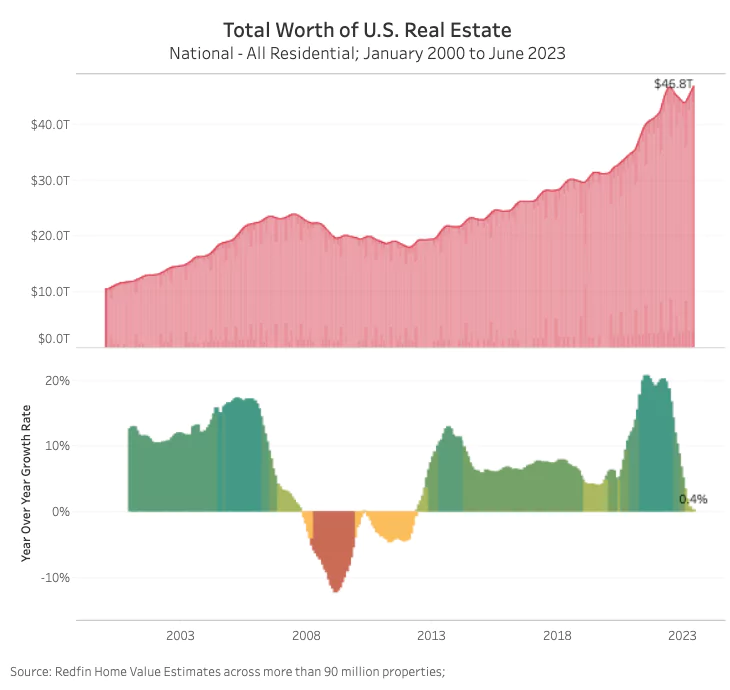
According to Redfin, the value of the housing market experienced a 5.3% annual increase ($2 trillion increase for a total of $47.5 trillion) in 2023, which is more than the total national debt ($34.8 trillion as of Q3 2024).

Value-of-US-homes-vs-national-debt

Value of US homes vs national debt

Source: https://www.investopedia.com/us-homes-got-a-usd2-trillion-value-boost-in-2023-8603202#:~:text=U.S.%20homes%20were%20worth%20more,lack%20of%20houses%20for%20sale.

Besides it being an enticing investment vehicle, here are other reasons to invest in real estate:

  • An additional source of income: Investing in rental property can help earn some passive income to cover the cost of the mortgage repayment and even supplement your earnings. The current market is especially lucrative as rents are rising faster than wages, with rents increasing by 4% between 2019 and 2023 compared to 20.2% for wages during the same period.
  • Potentially reduce your tax bill: There is a possibility of minimizing your tax burden by investing in real estate, such as deferring profits in a 1031 like-kind exchange or a Topic No. 701 personal-residence exemption for selling your home.
  • Diversify investment portfolio: You should consider investing in real estate as a hedge against losses when the stock market performs poorly. Diversifying your portfolio spreads your risk, improving your chances of navigating downturns unscathed.

Best Real Estate Investments in 2024

After extensive research, we found that these are the best real estate investments:

1. Rental properties

Becoming a landlord is a great way to earn some income. At the moment, the typical home is 37% more costly to buy than rent on a monthly basis, so naturally, more people are flocking to rentals.

As a result, rents for 2-bedroom apartments reached an all-time high of $1,716 in May 2023. Further, rental prices kept rising steadily, hitting $1,847 in March 2024.

However, remember that unless you hire a property manager, owning a rental property comes with extra responsibilities like maintaining the property, running adverts to find tenants, filing taxes, securing insurance, and paying the mortgage. On the other hand, hiring a property manager will mean a cut on your take-home.

2. REITS

Real estate investment trusts (REITs) are corporations or trusts formed to consolidate investors’ cash to buy, manage, and sell income-generating real estate properties.

They are bought and sold on major exchanges as you would stocks. A REIT pays 90% of its taxable profits to shareholders as dividends, so it does not have to pay corporate income tax.

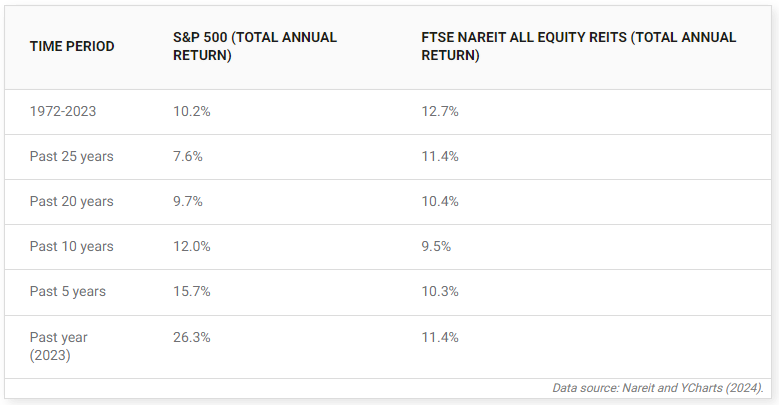
Unknown to many, REITs outperform stocks over the long term. Data from the FTSE NAREIT shows it performed better than the S&P 500 over the past 20, 25, and 50-year periods.

REITS-outperforms-the-S_P-500-in-the-long-term.

REITS outperforms the S&P 500 in the long term.

Source: https://www.fool.com/research/reits-vs-stocks/

Although all equity REITs made a loss of 5.8% in April 2024, they bounced back in May 2024, chalking up 3.1%. Mortgage REITs offered 12.5% in dividends, while Equity REITs chipped in with 4.2%.

All-REITs-performance

All REITs performance

Source: https://www.reit.com/data-research/data/quarterly-reit-performance-data

3. Real estate investment groups (REIGs)

These operate like mutual funds for rental properties. They are appropriate for the investor who does not have the time to manage real estate but wants to enjoy the benefits of a landlord.

A REIG is a company that buys properties and allows investors to join the group. You can own as many units as you wish. The company will then take charge of maintaining, advertising, and running the properties in exchange for a cut of the monthly rent.

There are different types of REIGs:

  • Equity REIG: The most common, where investors earn income generated from rent, capital gains, and appreciation. A REIG can invest in multiple types of properties, like commercial, residential, or industrial real estate. Aimed at cash flow and long-term growth and investors who don’t mind real estate’s volatility and illiquidity.
  • Debt REIG: Invest in debt instruments (such as mortgages and loans) secured by real estate. They generate income from fees, interest payments, and principal repayments. Are not as lucrative as Equity REIGs, but are less risky. Suited to investors looking for predictable and steady income geared toward capital preservation rather than maximizing returns.
  • Hybrid: Refers to a REIG that invests in both debt and equity instruments. Enjoys the features of both types of REIGs, providing a balanced result of income and growth while diversifying exposure to varied market conditions. Moderate risk for the returns.

4. Real estate limited partnerships (RELP)

Similar to REIGs, only RELPs are set up for a finite number of years. The general partner (an expert in real estate investments) will set up a plan to acquire a viable real estate project and seek investors to finance the property’s purchase in exchange for shares.

The partners might receive some income from the unit as they wait for an opportune time, as the end goal is the sizable profit they will hopefully receive from selling the property.

5. Mutual funds

Real estate mutual funds usually invest in real estate operating companies and REITs, allowing for diversified portfolio and exposure. Several investors pool their cash to purchase securities in REITs or companies investing in real estate.

A real estate mutual fund refers to pooled investment consisting of real estate and other diverse investment vehicles, such as stocks and bonds, placed under professional portfolio management.

Investors receive returns from real estate mutual funds in two main ways:

  • Capital appreciation: An increase in the net asset value could mean greater profits if the underlying property is sold at this higher value.
  • Dividends: Mutual funds announce dividends. Taxes are paid before distributing the dividends, so the proceeds are tax-free.

6. Multifamily homes

The multifamily segment is worth $3.8 trillion and is renowned for its stability, adaptability to market dynamics, and consistent cash flow. Investing in multifamily homes presents opportunities for multiple revenue streams with an annual cash-on-cash return rate of about 5-10%.

This figure reflects the rental income only but does not account for the returns you will receive if you decide to sell or refinance the property. Taking into account the sale of the profit bumps up the returns to 18-22% on average yearly.

A study by the National Multifamily Housing Council (NMHC) shows the multifamily sector offers the highest returns and lowest volatility of all commercial real estate (CRE) sectors.

Multifamily-units-outperforming-other-CRE-segments-in-the-long-run

Multifamily units outperforming other CRE segments in the long run

Source: https://www.nmhc.org/contentassets/98b98e79c61c48f5ab981ffbc7713a9b/explaining-high-apartment-returns.pdf

7. Farmland

This is an underrated and often ignored sector in real estate, yet it has one of the best ROIs. It is a market that was worth $3.18 trillion in 2022, covering about 52% of all US land base.

Non-operator farmland owners (they own the land but don’t actively participate in farming) accounted for 31% of all farms in 2014. In the past 30 years up to 2024, non-operator owners rented about 40% of all farmland.

Farmland-real-estate-growth-in-value

Farmland real estate growth in value

Source: https://www.ers.usda.gov/topics/farm-economy/land-use-land-value-tenure/farmland-value/#:~:text=The%20value%20of%20U.S.%20farmland,percent%20when%20adjusted%20for%20inflation.

The value of farmland increased by 7.4% in 2023, with a compound annualized growth rate of 4.6% for the period between 2017 and 2022. Average annual returns is 12.8%, and the sector has recorded positive returns yearly since 1990.

Contact Us Today

Strategies for Investing in Real Estate

These are the most popular real estate investing strategies:

1. Buy and hold

This refers to the practice where an investor buys a property, holds on to it long-term, and sells it when prices rise. With median home prices rising more than 200% over the past 20 years, it’s easy to see the appeal of this strategy.

You can also force appreciation by making improvements to the property, such as remodeling and raising the rent. Holding property for the long haul has several other benefits, such as tax shelter occasioned by depreciation and steady amortization of loans.

2. Fix and flip

This strategy involves targeting rundown homes, improving them, and selling them for a profit. Fix-and-flip investors enjoyed an average ROI of about 27.5% (gross profit of $66,000) in 2023.

Returns-on-house-flipping

Returns on house flipping

Source: https://www.attomdata.com/news/most-recent/home-flipping-plummets-across-u-s-in-2023-as-profits-slump-again/

However, you must possess knowledge of spotting structural issues in buildings to have any success using this strategy. If you don’t have the skills to gauge the structural integrity of properties, you could always engage experienced contractors or real estate agents.

Finding finances for the project might also be tricky because traditional lenders won’t advance you a standard mortgage for a fix-and-flip home. You can only rely on your savings or business partners.

3. Wholesaling

Find a property with great potential for high profits and link a buyer to the seller at a higher price than the selling price. Collect the difference in selling price and the amount the buyer pays.

It is heavily reliant on the “driving for dollars” technique, as most users of this strategy drive around neighborhoods looking for promising properties. You need a vast network of potential buyers and strong sales and marketing skills to pull this off.

4. BRRRR

It is short for “Buy, Rehabilitate, Rent, Refinance, Repeat.” It follows the same principles as fixing and flipping homes, but in BRRRR, you rent the unit instead of selling. After buying a distressed property, fix it, lease it, and once it has gained a history of cash flow, refinance and get cash to fund the next project.

It is a time and resource-intensive strategy, as you must have the resources to pull off the repairs without expecting to receive cash in the near future. You will also spend time managing the repairs and sourcing tenants.

Best States to Invest In

One of the best-known phrases in real estate is “location, location, location,” with good reason. Your success in real estate investments will have a strong relation to where you buy the property. Therefore, it is essential that you buy a property in the best real estate markets.

Each state has its own pros and cons, so it is critical that you familiarize yourself with information pointing to the suitability of investing in a particular state.

After an extensive review of real estate data, we’ve compiled the list below showcasing some of the best states to invest in:

1. Idaho

The 14th largest state’s median home price of $460,955 is reasonably above the US median home price of $363,438 in June 2024. Its GDP has grown by over 15% in the five years to 2023, and annual employment growth is 2.7%.

2. South Carolina

Homes are affordable, as they will set you back $301,130 only, while the value of homes increased by 3.7% between June 2023 and 2024. The state charges a lowly effective property tax rate of 0.50%, minimizing operating expenses.

3. Kentucky

This state is well suited to beginner real estate investors because homes cost just $251,300 as of June 2024, a 3% increase year-over-year (YoY). The typical rent is about $1,259, and there are no rent controls. Population growth is 0.32% YoY in 2023.

4. Indiana

With a median household income of $66,785, low cost of living (91.5), lowly home value of $242,500 (as of November 2023), and annual home appreciation rate of 6.1% between Q2 2022 and Q2 2023, Indiana presents an enticing prospect for real estate investment.

5. Georgia

The typical home has a manageable cost of $316,000. The median household income of $72,837 combined with a low annualized unemployment rate of 3.2% in May 2024 and a 1.3% jobs growth YoY in June 2024 place Georgia on the radar of most savvy real estate investors.

Final Word

Your best chance to stay ahead of the competition is to invest time learning and researching about the real estate business.

This will help you gain insights on making inroads in the industry and how to avoid potential pitfalls. Most of the information is readily available online on helpful sites such as BiggerPockets and Realtor.com.

Further, consult experienced contractors and real estate agents operating in your target area to learn more about the intricacies of the local market. They are a source of expert knowledge and networking opportunities when you start operating in that area.

Doctors claim they can’t seem to catch a financial break as inflation puts a squeeze on earnings, which is exacerbated by the widening gap between the rising cost of healthcare delivery and stagnating Medicare reimbursements.

Data points out healthcare prices grew faster than other components of the economy, rising by 3.3% between 2001 and 2021, unlike all goods and services, which only expanded by 2.2% during the same period.

However, the Bureau of Labor Statistics (BLS) data shows health insurance experienced a yearly rise of 28% in September 2022, higher than the inflation rate of 8.2%. Moreover, although health prices traditionally outpace inflation, the consumer price index (CPI) grew by 3.5% in March 2024, while medical prices rose by only 2.2%.

So, does this prove doctors are better off? Not really.

There seems to be a downward spiral of doctors’ earnings, with a study pointing to a 24.9% decrease in inflation-adjusted reimbursements to radiologists per beneficiary between 2005 and 2021. This article provides an in-depth analysis of the effect of inflation on Medicare reimbursements and its contribution to impoverishing doctors.

The Rising Cost of Healthcare Delivery

The government uses the Medicare Economic Index (MEI) as a measure of inflation in medical practice costs. 2024’s adjustments in reimbursements (effective 7/1/2024) raised the MEI percentage to 4.7%, up from 3.8% in 2023. This is the highest MEI percentage this century.

The American Medical Association (AMA) compared the rise in physician payments to inflation and found it declined 29% between 2001 and 2024. This proves payments are not keeping up with practice cost inflation.

Physicians’ payments do not match inflation

Physicians’ payments do not match inflation

Source:  https://www.ama-assn.org/system/files/2024-medicare-updates-inflation-chart.pdf

This is in stark comparison to other health professionals who have their annual increases based on MEI. If that were to apply to physicians, they would have seen their payments increased by 4.6%, not reduced by 4.7%.

John Corker, MD, emergency physician, put it succinctly:

“…over about the last quarter-century, doctors’ offices and physician practices have been dying a slow death by a thousand paper cuts as it pertains to Medicare reimbursements.”

From 2001 to 2021, physicians’ pay dropped by 1.1% per year on average, for a cumulative decline of 20%. The pay diminished a further 4% (adjusted for inflation) between 2021 and 2023.

Medicare payments compared to inflation (2001 to 2021)

Medicare payments compared to inflation (2001 to 2021)

Source: https://www.ama-assn.org/system/files/medicare-pay-chart-2021.pdf

By comparison, the CPI grew by 3.5% in March 2024 year-over-year (YoY) compared to a 2.2% rise in medical care prices. This does not follow the usual trend as medical care prices typically outpace the CPI historically.

CPI vs. medical care prices

Source: https://www.healthsystemtracker.org/brief/how-does-medical-inflation-compare-to-inflation-in-the-rest-of-the-economy/#Annual%20percent%20change%20in%20Consumer%20Price%20Index%20for%20All%20Urban%20Consumers%20(CPI-U),%20January%202001%20-%20March%202024

Increased costs of medical equipment, supplies, and technology

The cost of inpatient and outpatient hospital and related services (7.7%) and nursing homes (3.9%) rose higher than physicians’ services (0.7%) and prescription drugs (0.4%). By 2021, an estimate shows the average pharmaceutical supply costs increase by nearly 12% annually ($10.21 million per hospital in 2014 vs. $18.4 million in 2021).

Medical surgical costs increased by about 6.5% on average between 2017 and 2021. Digging deeper, the costs went up by 3% between 2019 and 2020 compared to a 10% increase between 2020 and 2021.

Rising cost of medical and surgical supply costs

Rising cost of medical and surgical supply costs

Source: https://www.definitivehc.com/resources/healthcare-insights/changes-in-supply-costs-year-to-year

This is impactful since medical and surgical supply costs make up about 35% of all hospital supply expenses. Moreover, the Centers for Medicare and Medicaid Services (CMS) predicted that hospital provider spending will increase by 50% between 2022 and 2030.

The impact of inflation on operational expenses

While supply and labor costs are rising, hospital margins continue to shrink. The AMA notes that the cost of running a medical practice between 2001 and 2021 grew by 39% (1.6% increase yearly increase), while the MEI leaped by 51% during the same period (2.1% annually).

With inflation still some way above ideal levels, hospitals are struggling to maintain staffing levels. Further, healthcare workers’ incomes were at a 4.5% deficit compared to national income levels in 2022. This has contributed to a nursing shortage estimated to run well into the near future.

Nursing shortage projections

Nursing shortage projections

Source: https://kpmg.com/kpmg-us/content/dam/kpmg/pdf/2023/the-impacts-of-inflation.pdf

Healthcare labor costs per adjusted hospital discharge increased by 25% between 2019 and 2022, with services at 16%, supplies at 18%, and pharmaceuticals at 21%. Labor costs still remain high, which could lead to a 10-20% deficit in registered nurses and a 6-10% shortage in doctors by 2025.

The Labor shortages could lead to a decline in health systems and cause access risks because of increased wait times and site-of-care closures. John Corker, MD, observed:

“…Doctors are forced to make difficult decisions about what days they can be open, what staff…they can afford to pay, and…what services they can provide for their patients.”

Schedule A Consultation With Us Now

The Stagnant Medicare Reimbursement System

The Biden administration slashed 2024 Medicare reimbursements by 1.25% from a year ago. This included a 3.4% decrease in the conversion factor. Keen observers would have noted this follows in the steps of a 2% reduction in physicians’ payments in 2023.

Data shows that health insurance prices in September 2022 had grown by 28% from the previous year, while inflation growth was only 8.2%. It came as no surprise when the shares of health insurers fell by 6% and 12% in April 2024 when announcements for the Medicare Advantage payments by the government signaled a cut in 2025 rates.

The rates were only a 0.2% drop from the previous rates but were enough to trigger suspicions of a margin squeeze from an industry grappling with high medical costs. Insurers are under pressure to lower the number of benefits due to the low rates and high costs.

How did we get here?

The formulas used to determine the prices of healthcare services are not only used to determine the prices in the prevailing year but are also used to update prices over time. In short, each year’s update is determined using projected changes in the “market basket index,” which is usually finalized in Q2 of the preceding year.

This quirk in price planning means projection errors sometimes occur and are often not accounted for when determining the payment updates. Failure to fix the error results in lower payments and creates a domino effect of lower prices in subsequent years.

For instance, the market basket increase projections for 2021 (made before the spiraling inflationary trends experienced at the back end of 2020) were determined at 2.4%, but the actual increase was 3.1%. The following year (2022), the projections of 2.7% were also made in Q2 2021 (during periods of relatively low inflation), yet the actual market basket increase was higher than 4.1%.

Projected vs actual market basket changes

Projected vs actual market basket changes

Source: https://www.brookings.edu/articles/what-does-economy-wide-inflation-mean-for-the-prices-of-health-care-services-and-vice-versa/

Remarkably, the market basket projections between 2009 and 2019 were 0.4% above the real increase on average.

How Medicare reimbursements are determined

Medical reimbursements are typically pegged at 80% of the cost of services provided, although they could drop to 75% for clinical social workers and rise to 85% for clinical nurse specialists.

The establishment rate schedule contains pre-determined base rates calculated using the resource-based relative value scale (RBRVS) grounded on a formula that takes into account several factors:

  • Complexity of service provided
  • Type of equipment used
  • Geographical location of the facility and services
  • Type of medical facility or professional
  • Adjustments for inflation on the services and procedures

It is multiplied by a conversion rate to determine the final disbursement.

Impact of inflation on the purchasing power of Medicare payments

Since healthcare services account for 16% of personal consumption spending on average, any changes in inflation will have some impact on Medicare payments. According to the Medicare Plans Patient Resource Center, nearly 33% of Medicare recipients spend 20-30% of their monthly wages on healthcare.

Most beneficiaries pay the base amount of Medicare Part B, which is adjusted yearly for inflation and is paired with the cost of living adjustment (COLA). The Social Security Administration determines the COLA increases since most premiums are deducted from social security benefits, and the goal is to ensure the stability of the beneficiaries’ buying power.

However, COLA does not always keep up with inflation. For instance, COLA was 5.9% in 2022, but the average inflation rate stood at 8%, which was not enough to cover Part B premiums.

The same trend is seen in Medicare Part D costs, where in 2020, prices of 50% of all prescription medications covered by Part D outstripped the inflation rate. Average prices rose from $31.47 monthly in 2021 to $33 in 2022. This meant Part D participants paid higher premiums for medication coverage and made more out-of-pocket payments.

John Corker, MD, observed:

“…And I think at the end of the day, it all comes back to access. If doctors can’t keep their doors open and they can’t have appropriate staff because of dwindling reimbursement rates for Medicare, patients can’t access services from their doctors.”

The Impact on Patient Care

Inflationary pressures could lead to a reduction in patient volumes, causing medical facilities to cut costs by reducing investments in healthcare. The financial pressures also affect doctors’ ability to provide quality care, and patients postpone or stop treatment to stay within their budgets.

For instance, when inflation breached a 40-year ceiling in 2022, about 38% of adults skipped or delayed treatment. They cut back on essentials like food and utilities or borrowed money to pay medical bills.

This could spell doom for 116 million people living with hypertension, 37 million with diabetes, and others with other chronic diseases who can’t afford to postpone or skip medication as it could be life-threatening.

People are forced to choose between day-to-day necessities, which compete with the need for healthcare. And if they were to decide to take on second jobs, the extra hours spent on working could harm their health. A study shows that for every $1 spent on healthcare benefits, $0.61 of productivity is lost to injury and illness.

A 2024 National Bureau of Economic Research study shows that every $100 (24.4%) decrease in the monthly budget for prescription drugs resulted in a 13.9% rise in deaths, primarily caused by patients cutting back on costly medication for hypertension, asthma, diabetes, and heart disease.

As Dr. Jason Goldman, MD, put it:

“…fix Medicare now, not just because physicians need to be paid fairly, but because the patients need their physicians. And if they do not fix Medicare, we will not have a healthcare system.”

It should also be noted that inflation raises costs in the long term, which can cause changes in behavioral health that may negatively impact overall health.

Potential Solutions

Several proposals have called for physicians’ pay to be tied to inflation. In late March 2024, the Medicare Payment Advisory Commission (MedPAC) recommended the pay be pegged at 50% of MEI, but the AMA proposed an annual inflationary payment update tied to the MEI.

That’s because the practice-expense part of physicians’ pay accounts for more than half of Medicare physicians’ payments. MedPac wrongly asserted that half of MEI covers all physician’s practice costs. However, this assertion omits the costs of running a medical practice, such as the energy, time, and expertise spent treating patients.

The AMA also called on congressional leadership to ensure physicians’ pay keeps up with inflationary growth in health care costs yearly. It is worth noting that physicians are the only providers who are unrepresented in the inflationary payment update.

This is especially important because a payment freeze is in place until 2026 and will resume at a 0.25% yearly increase indefinitely, although projections show clinician’s costs will rise by more than 2% annually from 2025 through 2033.

Final Word

While inflation is inevitable, the foremost issue physicians face is that Medicare reimbursements do not keep up with inflation. Further, the CMS estimates national health expenditure will grow 5.4% yearly from 2019 through 2028.

These will add to the cost of ballooning wages, capital, overhead, and maintenance costs, making it increasingly difficult to remain in practice. Physicians are faced with tough choices in the face of underpayment relative to inflation, forcing them to cut corners that negatively impact the provision of patient care.

Physicians will continue to feel the inflationary pressures for the next 2-3 years until the subsequent renegotiation of contracts to align payment with costs.

What can you do?

  1. Be a voice of change: Reach out to your congressman, association, patients, and state medical society and express your views on the matter.
  2. Optimize operations: Streamline operations to minimize wastage and hire staff appropriately.
  3. Network: Partner with other physicians or medical facilities to pool operational resources.

The real estate sector deals with tangible, real-world assets like land, homes, and buildings. It covers the residential, commercial, and industrial real estate segments. As you’ve probably guessed, it is one of the largest industries in the US, with the commercial and residential real estate segments commanding $113.58 trillion in market value in 2023.

On the other hand, cryptocurrencies are digital currencies operating on a blockchain, which is a cluster of records stored in a decentralized ledger. The cryptocurrency industry is an emerging industry with a global market value of $2.56 trillion as of June 13, 2024.

Although crypto operates on intangible technology, that has not stopped enterprising investors from finding investment opportunities in the real estate industry using the blockchain. This article explores the top six ways physicians can invest in real estate with cryptocurrency.

1. Buying Using Crypto

You can use crypto to buy property locally or internationally if the seller is willing to accept crypto. One of the great things about crypto is that it allows for fast transaction speeds at a lower cost, especially for overseas payments. For instance, there are about 1.1 million Ethereum transactions daily, which cost $1.4 per transaction on average.

For instance, if you were to purchase overseas property using traditional means, it must receive approval from a clearing house in the US and another where the property is located. A payment platform like PayPal will charge you 5% of the entire amount as transaction cost, while some financial institutions have a transfer limit.

Because some sellers and real estate platforms don’t allow crypto, new FinTech lending platforms in the market (like Milo) are allowing buyers to collateralize down payments with crypto. The platform provides crypto-collateralized mortgages in place of traditional down payment loans.

Moreover, buying real estate internationally using crypto can offer additional benefits. For instance, buying real estate in Montenegro and St Kitts and Nevis comes with the option of citizenship or residency. St Kitts does not charge capital gains tax on some investments like crypto under certain conditions.

Since Crypto prices fluctuate frequently, you might strike it lucky with its price rising before the transaction. That could save you some cash without even having to invest it. Ethereum, for instance, experienced an annual growth of 144.4% between May 2023 and May 2024.

Ethereum Growth Rate

Ethereum growth rate

Source: https://ycharts.com/indicators/ethereum_price

Note that a Lending Tree survey shows 38% of crypto holders said they made a loss when selling crypto. 28% asserted they made a profit, while 13% said they broke even.

2. Crowdfunding

Refers to using tokenization and blockchain technology to raise funds from several investors for a real estate project. This works like conventional crowdfunding but where real-world assets (RWA) are tokenized on a blockchain.

Under the arrangement, the block-based crowdfunding platform creates property-related tokens (PRT) aiming to raise money for the real estate project. The PRT represents a share of ownership of the RWA.

The global real estate crowdfunding market size brought in revenues worth $11.5 billion in 2022. It is projected to rake in $161.8 billion in revenue by 2030 at a compound annual growth rate (CAGR) of 45.9%.

Under Regulation D 504, a company can sell unlimited tokens to any number of investors, but the offering has a $10 million 12-month limit. However, under Regulation D 506(C), the offering is unlimited, but investors have certain limits.

Crowdfunding platforms enable pooling of resources from a wider audience of global investors. Further, they facilitate automation and digitization of the real estate transfer process, as well as near-instant trading and liquidity.

Some of the leading crypto-based crowdfunding sites include:

  1. KickICO: An Ethereum-based platform for donation and reward-based crowdfunding and initial coin offering (ICO). As a backer, you send a bid for tokens on a specific project, and if you are one of the highest bidders, you secure the tokens. The platform has helped entrepreneurs raise more than $500 million to date.
  2. RealT: The platform brings together experienced real estate and blockchain experts. It relies on the Ethereum and Gnosis blockchains to facilitate fractional investing. Investors worldwide can crowdfund and buy tokens of residential real estate properties in the US.
  3. WeiFund: This decentralized crowdfunding platform has pre-developed templates integrated with smart contracts, simplifying the campaign starting process. If a campaign does not hit the target, investors will receive refunds.
  4. Tecra Space: A blockchain crowdfunding platform aimed at raising capital for blockchain-powered projects, like the real estate Etherland project.

3. Tokenization

The blockchain has opened up a new avenue for expanding the reach of real estate by pioneering the concept of real estate tokenization by turning assets into digital tokens. One way to utilize tokenization in real estate is through fractional ownership.

Since investing in traditional real estate property requires hefty amounts of money to purchase (median home sale prices are currently at $420,000), fractional ownership enables investors to own a fraction of a real estate property.

This has seen the real-world tokenization industry move from a $0 market cap to over $300 million between January and September 2023. Global RWA payments volume hit $1.6 billion at the end of Q1 2024, with a total RWA supply of $533.3 million.

Growth Of Real-World Assets Tokenization

Growth of real-world assets tokenization

Source: https://www.vaneck.com/uk/en/blog/digital-assets/from-0-to-300m-market-cap-in-a-year-tokenized-real-world-assets/

The process utilizes smart contracts in a blockchain by converting the ownership rights of a fraction of the real-world property into a digital token on a blockchain. Each token represents a share of the asset, which you can sell or trade on digital platforms.

Tokenization facilitates faster sales of traditional property as the fractions are more affordable, transaction costs are lower (average cost per transaction is $0.000065), and assets are exposed to a broader, international market.

Even if you have the cash to buy a property outright, fractional ownership helps you buy fractions of properties in diverse markets, diversifying your investment portfolio and minimizing risk.

4. Real Estate Crypto Investing

Another way to take advantage of tokenization is to invest in real estate-centric cryptocurrencies. These innovative solutions combine the strengths of traditional real estate and the blockchain, enabling tokenized property investment.

According to a UK government survey, 63% of crypto investors reportedly made a profit, with 14% making a loss. Average profits and losses were under £500, while 8% reported making profits over £12,500.

These investments rely on a variety of ways to profit from the real estate industry, so you don’t have to do the research. Since they use cryptocurrencies, they operate globally, ensuring exposure to the best-performing markets. Examples include:

  • USP: A stablecoin pegged to the US dollar. The company maintains $2 worth of reserves in the form of real estate and cash for every token and commits to buying its token at a minimum of $1.
  • Propy: Leverages automation to facilitate real estate transactions. Users can buy or sell a real home using crypto, turn it into an NFT, and list it as such. The company uses its crypto, stylized as PRO, to facilitate transactions on its platform.

Alternatively, you could invest in companies with a heavy focus on cryptocurrencies. The crypto market is experiencing respectable growth, with data from Statista projecting it will experience an annual growth rate of 8.62% between 2024 and 2028, realizing an increase of $71.7 billion in that period.

Investing in a crypto-focused company could tap into the potential earnings if their stock rises as well. Examples of such companies include:

  • Milo: Provides mortgages to foreign nationals to help them invest in American properties. It offers a crypto-backed mortgage where investors can use their crypto as collateral to secure a mortgage. Borrow up to $5 million for 30 years.
  • Digital Currency Group: This is a venture capital company specializing in the digital currency market. The company buys, builds, and invests in blockchain companies. It reported revenues of $210 million in Q4 2023, up 59% year on year (YoY).

5. Investing in Digital Real Estate

Real-world real estate comprises physical properties, while digital real estate works in the same way but in virtual spaces. Digital real estate is a virtual property that users can interact with online in the metaverse.

Just like real-world assets, investors can buy, sell, and trade in digital real estate found in the metaverse, which is a 3D virtual world that allows users to log in and interact with their digital assets.

S&P Global Market Intelligence predicts the worldwide metaverse market revenue will grow from $17.5 billion to $54.5 billion between 2023 and 2028. Businesses accounted for 42.8% of the users in the industry by 2023.

You can use digital real estate in a variety of ways, such as building a mall and renting out shops to tenants. Some companies are even expanding their online footprint by recreating their real-world offices into the metaverse and holding meetings with clients in the virtual world.

The metaverse relies on the blockchain to record transactions because they are immutable, ensuring transparency and reputability of commerce on the platform. The blockchain also helps preserve data privacy, store data, and improve data interoperability.

The leading real-estate-related platforms in the metaverse include:

  1. Decentraland – Users utilize the MANA cryptocurrency to buy virtual plots of land turned in the form of NFTS. On June 11, 2024, Decentraland had a market cap of $835 million, with a trading volume of $46.4 million in 24 hours. The average land price for the same day was $344.75.
  2. The Sandbox – Players can own, develop, and sell land, represented as NFTs, using the SAND Ethereum-based token. As of June 11, 2024, its market cap for the past 24 hours was $893 million, with a volume to market cap of 21.72%.

6. Staking and Investing

Staking is one of the ways cryptocurrency holders can earn rewards while still holding onto the assets. If the crypto you’re holding allows staking, the blockchain will use it in the proof-of-stake validation process or lend it to third-party DeFi protocols engaging in yield farming, earning you passive income.

The global staking industry has a market cap of $334.86 billion, providing nearly $5.85 billion in rewards annually at a benchmark reward rate of 5.54%. As of June 11, 2024, the net staking flow for the last seven days was $16 million.

Annual percentage yield (APY) varies from platform to platform. For instance, staking the Crypto.com Coin on Coinbase will earn you a 7.77% APY on average if you hold it for a year. The coin has an asset market cap of $2.8 billion, with a staking market cap of $99 million. Other reputable platforms include Binance, OKX, and Kraken.

Staking follows a similar process as depositing cash in a savings account, with the bank lending the money and giving you interest on your balance. You can use the proceeds of the staking returns to invest in real estate. Some platforms like DappRadar can help you find the best staking options and provide detailed analytics and insights to maximize returns.

Alternatively, you could invest your existing crypto assets by posting them as collateral for a loan, which you can use to invest in real estate. There are plenty of traditional and decentralized financial institutions that offer this kind of service. Examples include Aave, Compound, and YouHodler.

Advantages of Investing in Real Estate Using Crypto

Using cryptocurrency to invest in real estate comes with several benefits:

1. Liquidity

Crypto is highly liquid, so it allows you to effect transactions quicker and more efficiently. Digital assets also have a history of fast buying and selling times, so you can trade them more often than physical real estate.

2. Global accessibility

You might not be able to access fiat currency wherever you go, but you can access cryptocurrency anywhere online. Crypto also facilitates frictionless cross-border payments as it has the same value in all countries.

Digital real estate also operates globally, so investors can access real estate markets in different countries without relying on the bureaucracy of traditional financial systems.

3. Lower transaction fees

Crypto transaction costs are much lower compared to traditional real estate transactions. Further, traditional real estate transactions are slow. Cryptocurrency transactions are faster, with transactions completed in minutes.

4. Automation

Part of the reason traditional real estate transactions are slow is that all parties need to meet face-to-face several times to iron out issues. The blockchain provides tools like smart contracts specifically tailored to real estate transactions.

Smart contracts automate the payment process, property transfers, compliance checks, auto-send for signatures, and retrieve verification information. This minimizes the need for manual processes and intermediaries, streamlining the process.

The intersection of real estate and cryptocurrencies offers opportunities for potential growth and diversification of portfolios. Conducting thorough market research will help you pinpoint viable investment opportunities.

Final Word

Cryptocurrency is a relatively new frontier compared to the more established fiat currency. That’s why entrepreneurs are developing innovative solutions to utilize crypto and the blockchain to facilitate real estate transactions, which are traditionally slowed down by bureaucratic practices.

Some of the solutions include tokenization of real estate assets, staking and investing in real estate-friendly projects, and pooling resources in crowdfunding platforms. These solutions have enabled faster and cheaper transactions and opened the market to international investors, ensuring faster disposal of real estate assets.

Before investing in crypto and real estate, be aware that these markets are risky. Conduct thorough research before making an investment decision in the two.

Central Bank Digital Currencies (CBDCs) are a new entrant in the world of finance, even newer than cryptocurrencies. They are a type of currency promising faster transaction speeds at a lower cost than traditional currency.

At their core, CBDCs are digital currencies that operate on the blockchain, like cryptos. So, are CBDCs a plot by Central Banks to replace crypto, or are they designed to work alongside one another?

This article examines CBDCs and cryptocurrencies and their use cases and investment options for physicians.

The Concept of CBDCs

The most common medium of exchange we are conversant with is fiat currency, typically in the form of banknotes and coins. A CBDC is the digital currency equivalent of fiat currency—it has all the functionality and utility of fiat currency but in a digital form.

97% of the money currently in circulation is in digital format, mostly from checking deposits. However, CBDC differs from normal digital cash because it is a direct liability to the Central Bank, like coins and paper money.

CBDCs operate like cryptocurrency—users utilize digital wallets for transactions, which are recorded in a blockchain database. Unlike cryptos, CBDCs are managed by Central Banks. This is aimed at enabling the government to manage money more effectively.

They eliminate the threat of private entities controlling a country’s economy. For instance, Alipay and WeChat Pay account for 94% of all Chinese online transactions, which could lead to anticompetitive tendencies.

The leading CBDC, e-CNY, digitalizes some of China’s physical coins and notes that are already in circulation. e-CNY allows users to make e-yuan payments even in offline stores or without a charged phone. Like fiat currency, CBDC systems don’t require intermediaries to process payments, boosting efficiency and lowering costs.

CBDCs offer the same convenience as cryptos, and since they are backed by the Central Bank, they are more trusted. Its inherent properties have led to more widespread research and adoption of CBDCs.

Rise of CBDC usage

Rise of CBDC usage

Source: https://www.imf.org/en/Publications/fandd/issues/2022/09/Picture-this-The-ascent-of-CBDCs

Benefits of CBDCs

1. Increased stability

Cryptos are highly volatile since they are subject to market sentiment, and there is no regulatory body monitoring their performance. On the other hand, CBDCs have a central bank monitoring and regulating them, ensuring price stability.

For instance, when the US faced 40-year high inflation rates of 9.1% in June 2022, and the dollar index hit 20-year highs of 112.12 in September 2022, the Federal Reserve (The Fed) raised interest rates by 5.25% points between 2022 and 2023 in a bid to stabilize the dollar.

These measures have seen interest rates cool down to 3.36% in April 2024, although it is still not at the Fed’s target rate of 2%. The dollar index has since lowered to 104.43 in April 2024. A central bank can do the same for a CBDC since it controls it.

Cryptocurrencies have no entity controlling them, so their prices can rise and fall seemingly on a whim. For example, Bitcoin’s price hit $69,000 on November 10. 2021. By December 31, 2021, it was trading at $46,208. In January 2023, its price was $16,530, but it rose to $42,258 by the close of that year.

Bitcoin’s price swings

Bitcoin’s price swings

Source: https://www.investopedia.com/articles/forex/121815/bitcoins-price-history.asp

2. Easier integration with traditional finance

Central Banks have designed CBDCs to operate seamlessly with the available cryptocurrencies and blockchains, which could enhance interoperability between digital and traditional finance systems.

3. Legitimacy

Cryptocurrencies are plagued by legitimacy concerns since no one controls the blockchains in which they operate. CBDCs are a cure for this as central banks regulate them, encouraging more people to invest in them as there is a familiar entity to ensure fairness in dealings.

A poll covering 13 countries found that most respondents prefer digital currencies issued by their central banks rather than private entities (by 13 percentage points). They also inferred that safety and privacy are the most essential features of a digital currency, even more important than convenience. 

4. Regulatory compliance

Since CBDCs are developed by Central Banks, they are more likely to adhere to regulations. The banks give clear guidelines on their usage, eliminating uncertainty.

Regulators are still coming to terms with crypto, so they keep on enacting laws that could be detrimental to their development and operations.

5. No need for a bank account

6% of US adults are still unbanked and often rely on costly alternatives like money orders and payday loans. CBDC eliminates the need for a bank account to transact. All you need is a smartphone and a smart wallet to access your cash and transact at much lower fees.

Drawbacks  

1. Centralized

CBDCs are subject to government control, unlike decentralized cryptocurrencies. The disadvantages of centralization include:

  • Vulnerability to cyberattacks and hacking. The servers are in a centralized platform under the control of a single entity, so the information could be easily accessed once breached. Crypto, on the other hand, is stored in several decentralized ledgers under no one’s control, and the data is immutable. Any unauthorized changes to the data are rejected.
  • Lack of transparency. The Bank decides what information on transactions it will disclose, unlike cryptos.  
  • Manipulation by the Central Bank. Centralized monetary systems can be controlled by a central bank. They can make decisions in their best interests instead of letting market forces dictate pricing, as happens with cryptocurrencies.

2. Privacy concerns

They also come with the baggage of diminished privacy, which is hard-baked into cryptocurrencies. Moreover, CBDCs offer none of the finality or privacy protection of hard cash. The Bank does not know what dollar bill a person has. However, it can access information on the users of each CBDC and use that information as it deems fit.

How Can Physicians Invest in CBDCs?

CBDCs operate like cryptocurrencies, so most of the investment avenues applicable to crypto will likely work on them. Although CBDCs have limited investment opportunities since they are a relatively new concept, they present prospects for direct and indirect investments.

China launched e-CNY in January 2022 in 11 pilot areas, with special emphasis on trials in venues used in the Beijing Winter Olympics in February and March. Following its success. The central Bank has now run test pilots in 23 cities.

As of October 2021, 123 million individual and 9.2 million corporate wallets were operational, with a cumulative transaction value of about $8.8 billion. Although they have not released official figures, Central Bank officials estimate that by March 1, 2022, 261 million wallets were in operation, with transactions hitting approximately $14 billion.

Since then, the central bank governor says transactions grew to $249.33 billion by the end of June 2023, up from about $13.8 billion in August 2022. This growth was spurred by 950 million transactions. Interestingly, this only accounts for 0.16% of all China’s cash in circulation, so there’s still plenty of room for growth.

By buying shares in companies or projects that facilitate payment, growth, or asset management solutions for CBDCs, an investor could see their investment grow with mass adoption. For example, Project Cedar is developing a platform enabling cross-settlement of wholesale cross-border multi-currency payments.

Alternatively, you could invest in an organization that could potentially utilize the CBDCs. These include banks that have expressed an interest in adopting the new tech. FinTechs involved in digital payments are also likely to use it more often once it gains widespread usage.

Like crypto, an emerging investment class for CBDCs is exchange-traded funds (ETFs). These will track the price performance of the CBDCs, allowing investors to speculate on the price movements of foreign exchange and currency markets.

Like FX trading, users can buy and hold on to a CBDC in the hope that it will increase in value. If it does, the investor can sell it for a profit.

Though difficult, the key is to monitor trends, developments, and financial news to find the opportune time to make the investments.

What are Cryptocurrencies?

Cryptos are also digital currencies whose transactions are recorded, verified, stored, and run on a decentralized system of distributed public ledger called the blockchain. Before any transaction is recorded, it must be agreed upon by the nodes that maintain the ledger. Cryptos facilitate secure digital payments and can also be used for investing.

How Physicians Can Use Crypto to Manage Their Finances

Physicians can utilize crypto in several ways:

1. Savings for the practice

One of the underrated uses of crypto or the blockchain is its ability to minimize costs since no intermediaries are used to transfer the funds.

For example, the World Food Program implemented the Building Blocks blockchain pilot program in Jordan in 2017, which enabled the organization to save $2.4 million in reduced administrative and transaction costs.

2. Streamline operations

The healthcare industry faces widespread inefficiencies, with experts estimating it loses 25% in wasteful spending annually. Inefficiencies in the supply chain also add up to 50% in operational costs.

The blockchain can replace and hasten the manual inventory management process, which is error-prone and requires frequent upkeep. Using the blockchain might improve the tracing of supplies, and smart contracts can trigger supply chain operations like ordering supplies, reducing operation time and reliance on third-party verification.

Streamlining operations is such a crucial part of doing business that a survey shows that 70% of retail and manufacturing businesses have started shifting to digital supply chain operations.  

3. Yield farming

If you have some cash lying in a low-interest bank account and have the appetite for a high-risk high-return venture, try yield farming.

It is a form of investing otherwise known as liquidity mining, where you can lend your crypto assets or set a smart contract that automatically moves your crypto holdings to a blockchain network paying the highest interest. Yield farms can offer annual percentage yields (APY) of over 200% compared to Bank APY’s of 1-4%.

Since crypto prices are highly volatile, prone to interest rate fluctuations, and smart contracts can fail, this is a risky venture. Token pools like Venus, Uniswap (V3), Curve Finance, and PancakeSwap (V2) offer reasonable returns.

4. Staking crypto

Another passive way to earn some returns is to lock your crypto assets on a certain blockchain and agree not to sell or trade it (staking). For example, about 27% of all the Ethereum is staked as of May 30, 2024.

Biggest cryptocurrencies based on total staked value as of December 5, 2023

Biggest cryptocurrencies based on total staked value as of December 5, 2023.

Source: https://www.statista.com/statistics/1279011/crypto-staked-value/

You will receive interest or rewards in return. Data from Statista shows rewards can go as high as 19.7%.

Benefits of Cryptocurrencies to Physicians

1. Lower fees

Crypto transaction costs can be lower than traditional bank charges, especially for international transfers. A physician can take advantage of this when processing and paying for supplies from abroad.

2. Faster turnaround

Some payment options, like wire transfers, have long wait times, often lasting 1 to 2 business days. You can complete a transaction on the blockchain in a matter of minutes, even when sending money to offshore suppliers.

3. Immutability of records

Data is recorded on the blockchain, and it cannot be changed. This enables secure storage of sensitive information, like patient records, or data prone to manipulation, like inventory figures.

Drawbacks

1. Limited acceptance

CBDCs are supplied by the country’s Central Bank, so they are legal tender. Some countries may limit the usage of cryptocurrencies, while countries like China, Bolivia, and Saudi Arabia have banned crypto usage entirely.

2. High risk

Compared to most other options, cryptocurrency investing is one of the riskiest. It is subject to extreme volatility and regulatory uncertainties.

Using a Two Sigma Factor Lens, not including the crypto factor, 90.76% of Bitcoin’s risk between January 2015 and March 30, 2021, is inexplicable. By comparison, the S&P 500 showed a less than 1% residual risk over the same period.

Bitcoin’s risk

Bitcoin’s risk

Source: https://www.twosigma.com/articles/risk-analysis-of-crypto-assets/#:~:text=91%25%20of%20Bitcoin’s%20risk%20since,lower%20than%20that%20of%20Bitcoin’s.

Final Word

The best investment vehicle for your particular case will depend on your risk appetite. If you are risk averse, investing in CBDCs could be the right move. The Central Bank is directly liable for it, and its value is usually pegged on the national currency, enhancing price stability.

If you have the stomach for higher risk, cryptocurrency investing is the way to go. Market forces dictate crypto prices, so there’s potential for higher returns. Besides investing, crypto could help cut transaction costs and streamline operations by automating some tasks in supply management.

Gallup released a report on Americans’ favorite long-term investment options. The findings showed that the top 3 investment assets were real estate, gold, and stocks.

Investing in either one of these could prove a prudent decision, but which is best?

The statistics show at least 65.9% of Americans own their homes, while 61% own stocks. Only 38% of retail investors have ownership of physical gold. Considering a survey asserts that 40% of American adults now own cryptocurrencies, we’ll include it in this analysis.

We’ll provide all the top reasons for investing in each of these assets, possibly helping you determine the best option.

A. Why Invest in Real Estate

In the 2023 Gallup report, 34% of Americans thought real estate was the best long-term investment. And it’s easy to see why.

Real estate is often at the apex of passive income streams, as its value generally increases over time and helps its owners build equity. Further, real estate is a great hedge against inflation since a rise in inflation almost always means an increase in prices, delivering positive returns in the long run. Here’s why you should consider investing in real estate:

1. Appreciation

Fluctuations in interest rates influence the mortgage rate and real estate affordability, consequently impacting demand for real estate. The current 30-year fixed mortgage interest rate average of 7% is partly to blame for the stratospheric rise in housing prices.

Predictably, housing affordability has been on the decline. The National Association of Realtors (NAR) found that a 7.7% increase in monthly mortgage payments in March 2024 year-over-year (YoY) contributed to a 4.7% increase in the median home price.  

Despite all this, home prices continue to rise, reaching all-time highs of $552,600 in Q4 2022 and still persist beyond the half million mark to date. Even with the stubbornly high mortgage rates, home sales remain beyond the 4 million mark, only dropping below this once in 2023.

Real estate performance over time

Real estate performance over time

Source: https://www.redfin.com/news/housing-market-value-hits-record-high-2023/ 

2. Hedge against inflation

Generally, a strong economy fuels housing demand as more people have the money to buy homes, and the opposite is true.

For instance, the US economy faced headwinds in the past four years, with the economy contracting for consecutive quarters in 2022 and 2023, hitting lows of -2% in Q1 2022. The Federal Reserve (Fed) instituted a series of interest rate hikes in a bid to tame runaway inflation.

Despite this, median rent prices hit all-time highs of $2,054 in August 2022. Home median sale prices also reached all-time highs of $432,525 in May 2022 and still lurk beyond the $420k mark to date.

3. Diversified portfolio

You might think the real estate industry is a monolithic investment path limited to buying and selling property, which is a preserve of the rich. However, it is much wider than this, enabling even investors of modest means to dip their toes in the industry:

  • Renting out property: Purchase and let rental property. Use the proceeds of the rent to pay the mortgage fees. Only 65.7% of American adults own their own home as of Q4 2023, so there’s still plenty of market for rental housing.
  • Real Estate Investment Trusts (REITs): Combines the liquidity of a stock with the ease of owning…a stock. Investors earn returns from real estate appreciation and dividends, too. National Association of Real Estate Investment Trusts data shows REITs outperform stocks on 20-50 year horizons, providing 12.7% annual returns vs 10.2% average stock market return from the S&P 500 between 1972 and 2023.

Nareit Performance

Nareit performance.

Source: https://www.fool.com/research/reits-vs-stocks/

  • Real estate platforms: These platforms unite investors with developers seeking capital to finance projects. While some only allow accredited investors, some take advantage of fractional ownership, allowing investors to only purchase a fraction of the property. Fractional ownership has found some usage in the blockchain, enabling the tokenization of real estate properties.

B. The Case for Investing in Crypto

Cryptocurrencies have acquired a bad reputation for volatility, but high risk can come with great rewards. Understanding the characteristics of this emerging market could potentially hold the key to higher returns.

1. Potential for high returns

Most cryptocurrencies, like Bitcoin, have a supply cap. A limited supply creates scarcity, which might increase its value over time.

Bitcoin also has halving events, which slows down its rate of production. These halving events have historically led to increases in Bitcoin prices.

After the first halving event in 2012, Bitcoin’s price rose by 145% in the first 90 days, 982% after 180 days, and 7,851% a year after. On average, its price has increased by 2,908% a year after each halving. Even the most conservative uptick happened during the second halving, where the price appreciated 279% a year later.

Bitcoin has outperformed all other major asset classes in eight of the past ten years (2013-2023). Since its inception, Bitcoin has recorded 116.01% annualized returns compared to its nearest competitor, the S&P 500 index, which managed 13.48%.

Bitcoin vs. other asset classes

Bitcoin vs. other asset classes

Source: https://www.visualcapitalist.com/bitcoin-returns-vs-major-asset-classes/

2. Could be a hedge against inflation

Fiat currency is controlled by Central Banks, which can influence it to achieve a favorable outcome. Cryptocurrencies are different as they operate on the principles of decentralization, free from manipulation by any entity.

Cryptos like Bitcoin also go through halving events, which cut down their supply by 50% at set intervals. These measures ensure cryptos do not face the same inflationary pressures triggered by fiat currency supply growth, which could minimize loss of value due to inflation.

C. Why You Should Try Gold

Gold has held a special place in investors’ portfolios for a long time. It is the go-to investment in times of geopolitical and economic uncertainty for various reasons:

Gold reaches all-time high

Gold reaches all-time high

Source: https://www.xm.com/research/analysis/allNews/xm/technical-analysis-gold-unlocks-fresh-all-time-high-again-195318

1. Hedge against inflation

Gold has a proven track record of holding value, making it the perfect medium to hedge against inflation in times of economic turmoil. It has an inverse relation to other types of investments, usually rising in value when the economy is on shaky ground.

For instance, while the value of the S&P plummeted by 56.8% during the 2007-2009 financial crisis, the value of gold rose by 25.5%. Its value increased by 101.1% between 2008 and 2012.

It’s also a great option when faced with market uncertainty. When the Israel-Palestinian conflict began in early October 2023, gold prices gained 6.8% within a few weeks.

While inflation has failed to dial down to the Fed’s target of 2% since 2021, reaching highs of 9.06% in June 2022, gold rose by 8.57% between February and March 2024, easing past $2,300 an ounce, an all-time high.

2. Store of value

Gold prices are relatively stable compared to other investment assets like stocks. Using the Dow Jones Industrial Average (DJIA) as an example, gold has outperformed it in 43% of the years between 1925 and 2015, despite only a 2.1% average return annually compared to 7.3% for the DJIA.

Even during times of recession, the two-year average return for gold is about 1.65%, while the DJIA dipped to lows of 55% during the Great Depression in the 1930s. Gold even remains stable in the good times, performing 13% better on average in 26 of the 65 years without a recession.

Gold’s performance over the years

Gold’s performance over the years

Source: https://www.economicsobservatory.com/is-gold-a-safe-haven-for-investors#:~:text=Over%20the%20past%20100%20years,%25%20(see%20Figure%203).

D. Reasons to Invest in Stocks

A 2023 Gallup survey found that 61% of Americans own stocks. Stock ownership, on average, was 62% between 2001 and 2008. The top 1% hold 49.4% (worth $19.7 trillion), while the top 10% own 93% of all stocks. What is the allure of stocks?

1. Potential for higher returns

While stocks might be perceived as high-risk investments, they also possess the potential for high returns. They certainly provide higher returns than conventional investment options like gold, treasury bonds, and bank deposits.

For example, stocks returned a 10.4% yearly average between 1989 and 2017, compared to just 6.1% for bonds over the same time. Returns from the stock market can go as high as 40% yearly, but beware—they can also dip by as much as 40%.

2. Beat inflation

While stock prices are volatile, they tend to level off in the long run. Therefore, they are a great option as a hedge against inflation for long-term investors. As studied over the past 35 years, the stock market shows a positive return in nearly every 7 out of 10 years.

The average inflation rate has hovered around the 2 to 3% mark for the past 20 years (2003 to 2023), with the long-term inflation rate at 3.1% since 1913. Large domestic stocks recorded an annualized average return of 7.7% (or 9.8% with the dividends reinvested) over the same 20-year period.

Historical performance of the S&P 500

Historical performance of the S&P 500

Source: https://www.macrotrends.net/2526/sp-500-historical-annual-returns

3. Promising short-term investment

Nevertheless, one of the biggest draws for investing in stocks is the allure of handsome short-term returns. With luck, investing in stocks can yield astronomical returns.

While extremely rare, it is not unheard of to see a stock’s price jump 100% in a single day. For example, Gateway Industries stock rose 18,000% in a single day in February 2011 following a takeover announcement. Currently, meme stock AMC rose by as much as 120% on May 15, 2024, while GameStop finished the day 60% higher.

4. Liquidity

Stocks are generally perceived as highly liquid assets since you can convert them into cash more easily than investments like real estate.

For instance, the Nasdaq witnesses more than 4.4 million shares traded daily, involving more than 31 million trades. This is several magnitudes higher than the real estate industry, which only experiences about 4 million units traded monthly.

Stocks also list on stock exchanges with nationwide coverage, which means investors usually have a sea of buyers willing to take the stocks off their hands, for the right price.

5. Variety

Investors have a wide array of stocks to choose from, each offering different benefits:

  • Common shares: The most common type of equity investment. It offers a chance for capital growth when prices rise, earning dividends, voting for directors who run the company, and advantageous tax treatment.
  • Preferred shares: Reliable income stream and dividends paid before common shareholders. It offers higher income compared to common shares, with some allowing investors to plow the dividends back into the company.

A qualified dividend is a common dividend that meets the qualification requirements set by the IRS. Qualified dividends are usually charged at a capital gains tax rate, which can be lower than the income tax imposed on some taxpayers.

Investor Considerations

There’s no one-size-fits-all approach to investing since every investor has a unique set of circumstances that make them suited to one investment approach over another. These should be your top considerations before choosing any of these investment options:

Risk tolerance

Before investing, ask yourself, “How much risk am I comfortable with”? Understand that every investment carries some level of risk, although some are less risky than others.

From the choices above, crypto and stocks are the riskiest due to their high volatility. Gold and real estate are far less risky, so choose what fits your risk management strategy.

Younger investors have time on their hands, so they can either try the riskier options or settle on safer, longer-term options and reap the rewards of compounding.

Investment horizon

How long do you intend to hold your investments? Some investment assets, like stocks and crypto, are excellent for short-term trading, while others, like real estate, only really work if you hang on to them for the long term.

Liquidity needs

If you have no emergency fund, invest in stocks, gold, or the most popular cryptos since they are more liquid. Real estate is off the table as it is less liquid.

Investment goal

What is your goal? Are you aiming for income, capital appreciation, or a combination of both? The answer to this will determine which investment option is best.

For instance, gold might be great for capital appreciation but not for income generation. Most forms of real estate investment offer both appreciation and income, and the same goes for some stocks and cryptos.

Liquidity needs

What is your goal? Are you aiming for income, capital appreciation, or a combination of both? The answer to this will determine which investment option is best.

For instance, gold might be great for capital appreciation but not for income generation. Most forms of real estate investment offer both appreciation and income, and the same goes for some stocks and cryptos.


Conclusion

Stocks, gold, cryptos, and real estate are desirable investment options, each with its own pros and cons. Cryptos and stocks can be great for the short term; gold generally retains its value, while real estate usually appreciates in the long run.

Remember, all investments carry some risk, although some are riskier than others. There’s no universal approach to investing, as the best investment choice depends on your specific goals and financial situation. Exhaustively consider your investment horizon and risk tolerance to make informed choices.

For your own good, consult a financial advisor for personalized advice, especially if you intend to spend huge sums.